


Choosing between a vitamin C serum vs antioxidant serum comes down to your main skin goal. Vitamin C is an antioxidant that may help brighten uneven-looking tone, soften the appearance of dark spots, and support collagen. Broader antioxidant serums can combine several protective ingredients, offering a wider-ranging approach to everyday environmental stressors.
Both can fit into a thoughtful routine. It’s natural to wonder whether one is stronger, gentler, or better for daily use. The right fit depends on the ingredients, your skin’s tolerance, and the results you’re looking for.
Learn what vitamin C does, how antioxidant serums help defend against free radical damage, and how the two differ in focus and formulation. Understanding these differences can make choosing your next serum simpler and more intentional.
Key Takeaways
- Compare the vitamin C form and packaging: derivatives and protection from air and light can influence a formula’s stability.
- For a routine centered on visible discoloration, consider a vitamin C serum and pair daytime use with sunscreen.
- Look at the full antioxidant blend, not just one ingredient, when choosing broader support for skin exposed to environmental stressors.
- Introduce active products gradually, adding one new formula at a time so you can observe how your skin responds.
- Choose a serum that fits your routine and comfort level; a focused vitamin C formula and a broader antioxidant blend serve different priorities.
Vitamin C Serums: Are They Worth the Hype?
Vitamin C may support brighter-looking skin and collagen, but its form and packaging matter. Consider the ingredient, stability, and evidence before adding it to your routine.
Vitamin C Derivatives and Stability
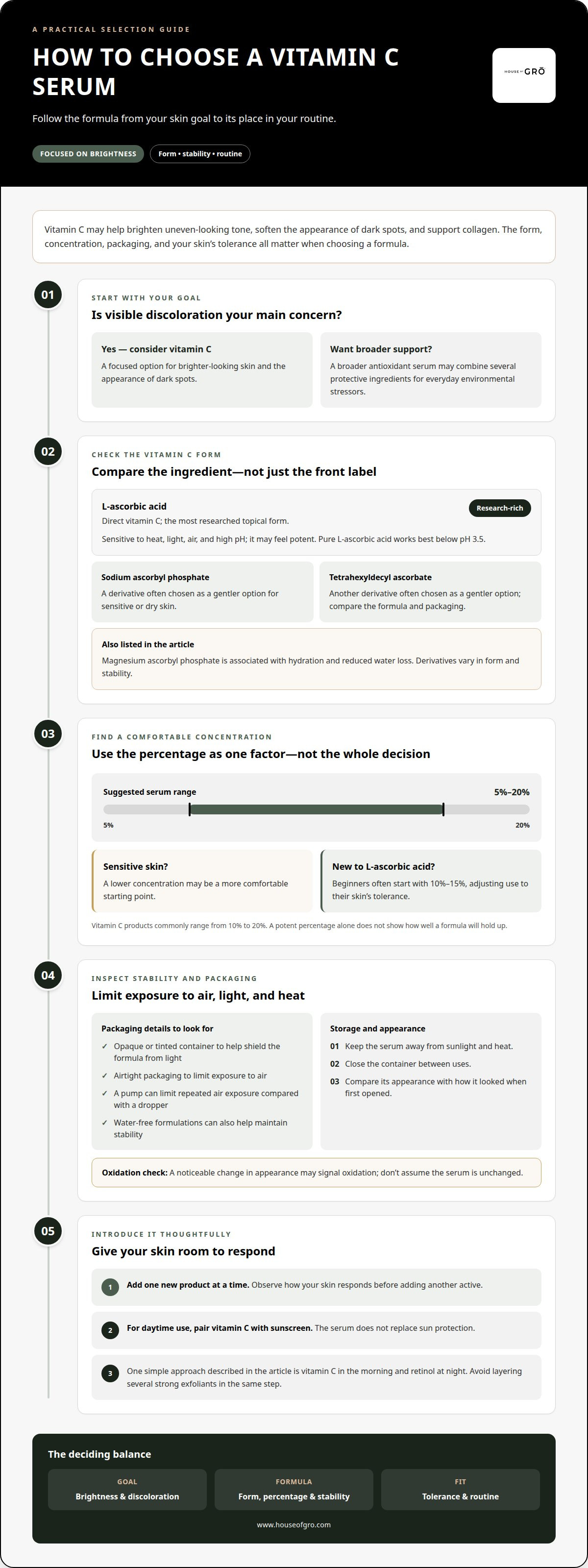
L-ascorbic acid is the most researched form of topical vitamin C, but it can be sensitive to heat, light, air, and high pH. Sodium ascorbyl phosphate and tetrahexyldecyl ascorbate are often gentler options for sensitive or dry skin. Magnesium ascorbyl phosphate is another derivative, associated with hydration and reduced water loss. Derivatives vary in form and stability, so check the ingredient list and formula details, not just the front label.
Storage and Oxidation
Keep vitamin C serum away from sunlight and heat, and close the container between uses. Opaque, airtight packaging helps limit exposure to light and air, which can oxidize vitamin C. A change in the serum’s appearance may signal oxidation; compare it with how it looked when first opened. If it looks noticeably different, don’t assume it is unchanged.
Packaging also shapes everyday use. A dark or tinted container helps shield the formula, while a pump can limit repeated air exposure compared with a dropper. Pure L-ascorbic acid works best below pH 3.5, and opaque, airtight packaging supports stability. Water-free formulations can also help maintain product stability. These details matter because a potent percentage alone doesn’t tell you how well a formula will hold up.
Concentration offers another point of comparison. Vitamin C products commonly range from 10% to 20%, while a suggested serum range is 5% to 20%. For sensitive skin, a lower concentration may be a more comfortable starting point. Beginners often start with 10% to 15% L-ascorbic acid, adjusting use to their skin’s tolerance. Introduce one product at a time and observe how your skin responds.
Look closely at claims of clinical testing. A useful product description should explain what was tested and how, rather than relying on “clinically tested” as a standalone phrase. One testing process considered 60 formulas, included 34 products over three months, and sent 20 strong contenders to eight panel testers. Tester feedback can show how a serum felt in a routine, but it doesn’t by itself establish a clinical result.
Vitamin C can support collagen production, which contributes to skin structure. It may suit goals such as a brighter appearance and smoother-looking texture. Results depend on consistent use and a stable formula. Pair daytime vitamin C with sunscreen; the serum doesn’t replace sun protection.
| Option | Form | Stability and use | Consideration |
|---|---|---|---|
| L-ascorbic acid | Direct vitamin C | Sensitive to light, air, heat, and high pH | Research-rich; may feel potent |
| Sodium ascorbyl phosphate | Vitamin C derivative | Often chosen as a gentler option | Consider for sensitive or dry skin |
| Tetrahexyldecyl ascorbate | Vitamin C derivative | Often chosen as a gentler option | Compare formula and packaging |
Choose a vitamin C form and formula that suit your skin’s tolerance and routine, and consider the concentration and protective packaging.
Why Choose an Antioxidant Serum Over a Vitamin C Serum?
Vitamin C is a focused choice for brighter-looking skin and visible discoloration. A broader antioxidant serum can suit a routine built around multiple protective ingredients and wider skin support.
For uneven tone, topical vitamin C may help brighten skin and reduce the appearance of hyperpigmentation. Its focused role can make it useful when dark spots are your main concern. Pair daytime use with sunscreen, since vitamin C doesn’t replace sun protection.
Brightening serum and vitamin C serum aren’t always separate categories. Vitamin C itself is used for brightening, while other brightening formulas may combine ingredients that address uneven-looking tone in different ways. Niacinamide, for example, is another ingredient used in brightening products. Compare the full ingredient list and the formula’s purpose rather than relying on the product name alone.
Multi-pathway formulas bring together ingredients with complementary roles. One formula might combine vitamin C with niacinamide; another may use antioxidants such as vitamin E or green tea extract. These blends can broaden a routine beyond one focused active. Check that the ingredients suit your skin and add a useful step, rather than layering products with overlapping purposes.
In the United States, serum cost varies with factors such as ingredients, concentration, formulation, and packaging. Compare those details and the product’s intended use instead of assuming every antioxidant blend or vitamin C serum costs the same.
Introduce new active ingredients gradually and pay attention to how your skin responds. One simple approach is vitamin C in the morning and retinol at night; avoid layering several strong exfoliants in the same step. When combining active ingredients, introduce products gradually and pay attention to how your skin responds.
When layering vitamin C with another brightening serum, apply the lighter-textured formula first. Introduce one new product at a time, giving your skin room to adjust before adding another active. This makes it easier to identify which ingredients feel comfortable and which steps suit your routine.
Choose vitamin C when brightness and discoloration are your central goals. Consider a broader antioxidant blend when you want several antioxidant ingredients in one step. For a quieter, ingredient-conscious approach to daily care, explore skincare for a considered routine.
How antioxidants protect against free radical damage
Pollution, ultraviolet radiation, and stress can contribute to free radical formation in skin. Free radicals are unstable molecules that can damage skin cells and accelerate visible signs of aging. Antioxidants help neutralize them and limit oxidative damage. This is a supportive role, not a shield against every environmental exposure.
Think of an antioxidant serum as one supportive step in a routine. A formula may contain vitamin C, vitamin E, green tea extract, or resveratrol. Each ingredient contributes antioxidant activity, while the blend shapes the formula’s particular approach. For example, a serum combining vitamin C and vitamin E brings together multiple antioxidant ingredients instead of relying on one.
Sun exposure can contribute to uneven tone and dark spots. Topical vitamin C may help brighten the appearance of skin and fade hyperpigmentation over time. It can also support collagen production. A vitamin C derivative such as sodium ascorbyl phosphate is still a form of vitamin C, though the formula and its stability affect how it fits into a routine.
Antioxidants can complement sun protection, but they don’t replace sunscreen. Vitamin C alone is only minimally effective at reducing sunburn. For daytime care, apply antioxidant serum before moisturizer and sunscreen. Sunscreen remains the final protective step. This pairing matters if your goals include a more even-looking complexion and ongoing care against UV-related stress.
Antioxidant serums also differ in breadth. A focused vitamin C formula may center on brightness and discoloration, while a broader blend can combine ingredients such as vitamin E, ferulic acid, or coenzyme Q10. Green tea extract and resveratrol are other examples. Read the ingredient list to see whether the serum offers a combination or centers on one active.
- For dark spots: choose a formula that includes vitamin C, then use sunscreen consistently during the day.
- For broader antioxidant support: look for a blend containing more than one antioxidant, such as vitamin E and green tea extract.
- For a simpler routine: start with one serum and observe how your skin responds before adding another active.
Consistency and layering shape how these steps work together. Apply serum to clean skin, then follow with moisturizer and daytime sunscreen. Introduce active ingredients one at a time rather than starting several formulas together. This makes it easier to notice irritation and identify which product suits your skin.
Antioxidants support skin against oxidative stress, while sunscreen addresses UV exposure directly. Together, these steps can support a routine focused on resilience, brightness, and a more even appearance. Keep expectations realistic: no serum erases every dark spot or prevents all damage, and visible changes depend on the formula and consistent use.
Vitamin E and ferulic acid as stabilizing ingredients
Vitamin E and ferulic acid may appear alongside vitamin C in antioxidant formulas. They add antioxidants to the blend and may support vitamin C stability. A serum’s performance still depends on its full formulation, concentration, and packaging. Look beyond one ingredient name to understand what the product is designed to do.
Ingredient counts offer one glimpse of common pairings. Among products tested, 26 contained vitamin E and 18 contained ferulic acid. Those figures describe the tested group, not every serum on the shelf. Vitamin E, ferulic acid, resveratrol, niacinamide, green tea extract, and coenzyme Q10 are all ingredients found in antioxidant blends.
These ingredients don’t make every formula interchangeable. A product centered on ascorbic acid has a different focus from a blend combining several antioxidants. Check the ingredient list for the specific forms included, then consider whether the concentration and overall formula suit your care routine. For example, a serum listing vitamin C with vitamin E and ferulic acid offers a different combination from one built around green tea extract and coenzyme Q10.
Vitamin C can cause a mild tingling sensation at first, and concentrations above 20% may cause minor irritation. People with sensitive skin can consider a lower concentration; those with very sensitive skin or rosacea should work with a dermatologist or skin care professional when choosing a vitamin C product.
Introducing active ingredients gradually helps you notice how your skin responds. Add one new product at a time, spacing new additions by a few weeks. For example, don’t begin a vitamin C serum and a strong exfoliant in the same routine change. If you’re combining vitamin C with a brightening serum, start using the pair 3-4 times per week and build based on tolerance.
For a careful first use, patch test a small amount and wait 24 hours before applying it more broadly. If vitamin C causes significant or persistent discomfort, stop using it. Sensitive or reactive skin benefits from a slower routine, especially when adding more than one active formula.
Read the directions and keep your routine simple while your skin adjusts. A morning antioxidant serum can go before moisturizer and sunscreen, while other actives can be introduced separately. The goal isn’t to use every ingredient at once, but to choose a blend that suits your skin and introduce it with care.
Antioxidant serums compared with vitamin C serums
The key difference is focus: vitamin C is one antioxidant, while broader serums can combine several. Choose based on your skin goal, the formula, and your tolerance.
Vitamin C Serums
A vitamin C serum centers on one antioxidant, often L-ascorbic acid or a derivative. This focused formula is commonly used to brighten the appearance of skin and address discoloration. Broader antioxidant serums may combine vitamin C with vitamin E, ferulic acid, or botanicals such as green tea extract. Check the ingredient list to see whether a formula is focused or combines several ingredients.
Hyperpigmentation, Dullness, and Aging
For hyperpigmentation or dullness, vitamin C offers a focused option because it may brighten skin and reduce the appearance of dark spots. Other antioxidants may offer broader support, including help with the appearance of fine lines, wrinkles, texture, and uneven tone. No single ingredient suits every goal; compare the formula’s purpose and ingredients with the concern you want to address.
For signs of aging, a well-formulated antioxidant blend may offer broader support against environmental stressors than vitamin C alone. Vitamin C remains relevant for tone and brightness, while ingredients such as vitamin E or ferulic acid can add antioxidant support. Use sunscreen during the day with either serum.
Vitamin C as an Antioxidant Serum
Yes. Vitamin C is an antioxidant, so a serum containing vitamin C is an antioxidant serum. The distinction is that “antioxidant serum” often describes a broader formula with multiple antioxidant ingredients, while “vitamin C serum” highlights one active.
For sensitive skin, the choice depends on both ingredients and formulation. A broader antioxidant serum may suit someone seeking gentle, broad-spectrum support, while potent L-ascorbic acid can irritate some people. Consider a lower-concentration vitamin C option if your skin is sensitive, and introduce any new active gradually.
Packaging also matters when comparing formulas. Vitamin C can be sensitive to air and light, so opaque, air-restrictive packaging can help preserve it. A blend with vitamin E, ferulic acid, or green tea extract may take a different formulation approach. Compare the ingredient list, container, and intended use rather than judging by “antioxidant” alone.
Use this decision guide: choose vitamin C when brightness or dark spots are your main focus; consider a broader blend for multiple antioxidant ingredients and wider environmental support. Either way, apply the serum before moisturizer and sunscreen in a daytime routine. Explore skincare essentials to find a considered addition to your daily ritual.
House of GRŌ®: AT DAWN Rejuvenating Daytime Oil
At Dawn Rejuvenating Daytime Oil offers a considered daytime step for those drawn to botanical skincare. House of GRŌ® creates formulas with adaptogenic mushrooms and organic botanicals, including wild-harvested Chaga, a key antioxidant ingredient. This is a different approach from choosing a serum centered specifically on vitamin C.
Choose At Dawn Rejuvenating Daytime Oil when you want to build your morning routine around a daytime oil. Keep your choice aligned with your priority: a focused vitamin C product for brightness, or a botanical-led routine that brings antioxidant ingredients into daily care. Sunscreen remains essential during the day.
Explore At Dawn Rejuvenating Daytime Oil at House of GRŌ® to see how it fits your intentional skincare routine.
Make Your Next Skincare Step Intentional
The best routine is one you can follow with care and consistency. Let your skin’s priorities guide your next choice, then give any new formula time to become part of your practice. Choosing between vitamin C serum vs antioxidant serum needn’t mean searching for the most complicated routine. Pick a clear direction and keep your daily care balanced.
House of GRŌ® also offers After Dark Restorative Night Serum and Touch Hydrating Body Serum for distinct moments of care in an evening or body routine. Choose each step with intention rather than adding products simply to make your routine longer.
If you’d like a thoughtful next step for your skincare routine, contact House of GRŌ® for skincare advice. Begin with what feels right for your skin, and let your routine grow with purpose.
Frequently Asked Questions
What does vitamin C do?
Vitamin C supports brighter-looking skin and collagen production. That makes it relevant if your complexion looks dull or uneven. It also contributes antioxidant support against environmental stressors, but it isn’t a substitute for sunscreen. Before adding it, consider your primary goal: tone, dark spots, or a broader approach to daily skincare.
Vitamin C serum benefits: What does vitamin C serum do for your skin?
A vitamin C serum may improve the appearance of uneven tone, dark spots, and dullness. It also supports collagen, which contributes to skin structure. For example, someone concerned about post-acne marks might choose vitamin C as a focused addition after cleansing. Use it consistently as directed, and include sunscreen in your daytime routine.
Can You Use Both?
Yes, you can use a vitamin C serum alongside a broader antioxidant serum, but layering both isn’t essential for every routine. If you use both, introduce one product at a time and apply the lighter texture first. Keep the rest of your routine simple while you assess skin tolerance. In the morning, finish with moisturizer and sunscreen. Avoid adding several new actives at once.
Can an antioxidant serum replace pure L-ascorbic acid?
Not if your specific aim is to use pure L-ascorbic acid. A broader antioxidant formula may contain other antioxidants or vitamin C derivatives, which differ from pure L-ascorbic acid. It can still suit a routine built around a combination of ingredients. Read the ingredient list to identify the vitamin C form and decide whether it matches your preference.
Should you use an antioxidant serum in the morning or at night?
Antioxidant serums are generally used in the morning, before moisturizer and sunscreen. This makes them a daytime routine step alongside sun protection. If you prefer evening care, follow the product directions and consider how it fits with other actives. For example, if your night routine already includes retinol, you might use vitamin C in the morning instead.
What Are Antioxidants, and Why Do They Matter?
Antioxidants help neutralize unstable molecules called free radicals. These molecules can contribute to skin damage from environmental exposures, including pollution and UV radiation. Ingredients such as vitamin C, vitamin E, or green tea extract can provide antioxidant support in a routine. Sunscreen remains important because antioxidants don’t block UV exposure as sun protection products do.
What is the difference between vitamin C serum and antioxidant serum?
Vitamin C is one antioxidant, so a vitamin C serum is a type of antioxidant serum. The broader term often refers to formulas combining several antioxidant ingredients, while vitamin C serum highlights vitamin C as a central active. When comparing vitamin C serum vs antioxidant serum, start with the ingredient list and your priority: a focused brightening step or a multi-ingredient blend.
What are the benefits of vitamin C serum for skin?
Vitamin C serum may support a brighter appearance, reduce the look of dark spots, and support collagen production. It also adds antioxidant care to a routine. To assess whether it fits, choose one concern, such as dullness, and use the product consistently as directed. Avoid introducing several new active products at the same time.