


For skin, chaga tincture vs. extract comes down to more than terminology: a tincture is a liquid preparation, while “extract” can describe a broader range of concentrated ingredients. Neither should be applied to skin unless it is formulated for external use. Topical chaga products are made for skin and may combine chaga extract with moisturizing ingredients.
The terms can be easy to confuse. Both begin with chaga, but preparation and intended use matter when choosing a product for your routine.
This guide explains how tinctures and extracts differ, how chaga is used in topical skin care, and what to consider for safe application. It also covers what current cosmetic research can and cannot tell us, so you can assess chaga as an ingredient without treating it as a promised skin treatment.
Key Takeaways
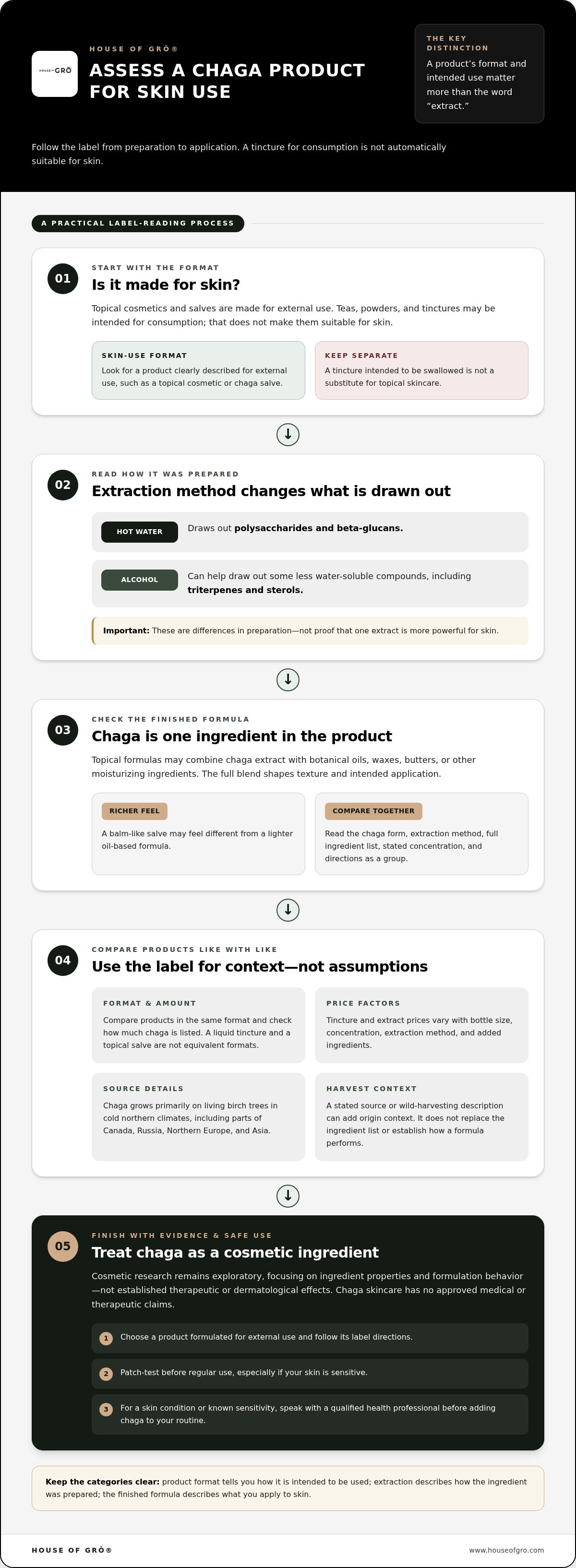
- Choose chaga products by intended use: a tincture for consumption isn’t automatically suitable for skin.
- Extraction method matters. Hot water draws out polysaccharides and beta-glucans, while alcohol can help extract some less water-soluble compounds.
- Chaga in topical cosmetics is an ingredient with exploratory research, not an established skin treatment.
- Patch-test a topical product before regular use, especially if your skin is sensitive.
- For a skin condition or known sensitivity, speak with a qualified health professional before adding chaga to your routine.
How Is Chaga Used in Skin Care Products?
Chaga appears in topical formulas and products intended for consumption. The format determines how it is prepared and how it should be used.
Topical Products and Other Chaga Formats
Topical chaga products are made for external use, unlike teas, powders, and tinctures. A product intended to be swallowed is not automatically suitable for application to skin. Chaga salve, for example, is an ointment infused with chaga extract. Other formulas may combine the extract with botanical oils, waxes, butters, or moisturizing ingredients.
Tincture and Extract Differences
A tincture is a liquid preparation, while “extract” can refer to chaga ingredients made using different methods. Hot-water extraction draws out polysaccharides and beta-glucans; alcohol extraction can help draw out some less water-soluble compounds, including triterpenes and sterols. To compare products, read the extraction method, full ingredient list, and stated concentration together. These details help distinguish a concentrated ingredient from a finished topical formula.
In the United States, tincture and extract prices vary with bottle size, concentration, extraction method, and added ingredients. Compare products in the same format and check how much chaga is listed, rather than assuming a topical salve and liquid tincture are equivalent.
Sourcing offers another useful comparison point. Chaga is a slow-growing fungal conk found primarily on living birch trees in cold northern climates. It occurs across parts of Canada, Russia, Northern Europe, and Asia. Product descriptions that identify the source and say whether chaga is wild-harvested provide context about the ingredient’s origin. These details do not replace the ingredient list, but they make sourcing easier to assess.
In infused skincare, chaga extract is one component of a finished formula. The accompanying oils, waxes, butters, and moisturizing ingredients shape the product’s texture and intended application. A balm-like salve differs from a lighter oil-based formula, even when both contain chaga. Cosmetic research on chaga remains exploratory, focusing on ingredient properties and formulation behavior rather than established therapeutic or dermatological effects.
For a practical label comparison, look for the form of chaga, the extraction method, and the other ingredients. Then check whether the product is described for external use or consumption. A tea or powder belongs to a different use category from a skincare salve. Keeping these formats distinct helps you compare like with like and choose a product that fits your intended routine.
A tincture is a different format from a finished topical product, so keep its intended use clear when comparing them. For tinctures, follow the product packaging instructions for the recommended chaga tincture dosage. This guidance applies to that product and does not make a tincture intended for consumption suitable for skin application.
The page’s DIY chaga face mask recipe uses 1 tsp of chaga powder. That amount belongs to the recipe, rather than serving as a general measure for every chaga product or topical formula. Keep the recipe distinct from ready-made skincare, and use each product according to its stated purpose and packaging instructions.
Chaga extract in topical cosmetics
Use chaga extract in a skincare routine only through a product formulated for external use. After cleansing, apply the cosmetic as its label directs. A tincture intended for consumption is not a substitute for topical skincare.
In cosmetics, chaga extract is an ingredient in a finished formula, not a complete routine on its own. The formula may pair it with botanical oils, waxes, butters, or moisturizing ingredients. These supporting ingredients affect texture and application, so a chaga balm and a lighter serum can feel very different on skin.
Extraction also shapes what the ingredient contains. Hot water draws out polysaccharides and beta-glucans, while alcohol can help extract some less water-soluble compounds, including triterpenes and sterols. These are differences in preparation, not proof that one extract is more powerful for skin. Cosmetic research remains exploratory, focusing on ingredient properties and formulation behavior rather than established therapeutic or dermatological effects.
That distinction matters when you read product claims. A cosmetic description can explain an ingredient’s role or the formula’s intended use, but it is not evidence that chaga treats a skin condition. Chaga skincare has no approved medical or therapeutic claims. Treat it as a cosmetic ingredient, not a replacement for care addressing a diagnosed concern.
Assess a product by reading its ingredient list and directions together. Look for chaga extract among the ingredients, then note the base formula. Oils and butters, for example, may create a richer balm, while a different base can make a product easier to spread. The label also helps distinguish a topical cosmetic from a tincture or powder intended for another use.
Origin adds context, but it does not establish how a formula performs. Chaga grows primarily on living birch trees in cold climates, including regions across Canada, Russia, Northern Europe, and Asia. If a brand describes its sourcing, treat that information as background about the raw ingredient. The finished cosmetic still depends on the extraction method and complete blend of ingredients.
Environmental conditions and sourcing practices can matter when choosing botanical ingredients. Chaga is a slow-growing fungus, so its origin and harvesting description can clarify where the ingredient comes from. These details do not tell you the extract’s concentration or demonstrate a skin benefit. Keep the questions separate: sourcing describes provenance, while the ingredient list and directions describe the cosmetic you’ll apply.
For a considered routine, choose a product clearly made for skin, follow its directions, and do not treat ingredient language as a medical promise. The extract, supporting formula, and intended use all matter. This distinction makes chaga easier to understand as one part of a cosmetic formula.
Chaga safety and application
Safe use starts with distinguishing topical chaga from products intended for consumption. A tincture taken by mouth is not automatically suitable for skin, and a cosmetic is not a substitute for medical care. Follow the directions for the specific product: an ointment, liquid tincture, and formulated skincare product have different uses.
Before regular use, patch-test a topical chaga product, especially if your skin is sensitive. Apply it according to its directions and observe the test area for a reaction before adding it to your routine. If you have a skin condition or known sensitivity, discuss the ingredient with a qualified health professional. They can consider your condition and the other products you use.
For chaga salve, start with clean, dry skin, then gently massage the ointment into the intended area. Follow the product’s own directions, since a salve and a cosmetic serum may differ in how they are applied. Do not treat a topical formula as an oral supplement, even when both products contain chaga.
Ingested chaga raises a separate consideration. Chaga can be high in oxalates, which may concern people with kidney disease, a history of kidney stones, or oxalate-related health issues. This matters when considering tea, powder, or tincture for consumption. A skincare product used externally is a different category from a supplement taken by mouth.
If using a chaga tincture orally, follow the dosage directions on its packaging. Product directions may specify 30-40 drops per dose, up to 3 times daily; those figures describe the product directions, not a universal dose for every tincture. A tincture can be added to water, tea, or juice. Don’t transfer directions from one bottle to another, since concentration and preparation can differ.
Chaga’s compounds, including polysaccharides, do not remove the need to consider the complete formula and intended use. The fungus grows primarily on living birch trees in cold climates, but its origin does not establish how a particular product will suit your skin. Keep the assessment practical: identify whether the product is topical or oral, read its directions, and consider your personal sensitivities before use.
Chaga cosmetics have no approved medical or therapeutic claims. Use a topical product for its cosmetic purpose, not to treat a diagnosis or replace professional care. For example, if you are considering chaga salve for a persistent skin concern, discuss that concern with a qualified health professional rather than relying on the ingredient alone.
For a DIY chaga face mask, the page suggests leaving it on for 10-15 minutes before rinsing. That interval is specific to the mask suggestion; it should not be carried over as an application direction for a salve, tincture, or another skin-care product. Keep the distinction between preparations clear, and follow the directions for the particular product being used. The suggested timing does not change the need to assess whether the formula is suitable for your skin.
Chaga tincture for skin and wellness
A chaga tincture taken for wellness is not a proven skin treatment. Topical chaga tinctures or extracts haven’t been shown to treat skin conditions, and chaga skin care has no approved medical or therapeutic claims. Cosmetic research remains exploratory, focusing on ingredient properties and formulation behavior rather than demonstrated dermatological effects.
This distinction matters because “medicinal” language can make a wellness product sound like a treatment. A tincture taken by mouth and a cosmetic applied to skin have different intended uses. One route does not establish benefits through the other. Drinking a chaga preparation, for example, does not show that it will reduce redness, change pigment, or treat a diagnosed condition.
If you’re comparing chaga tincture vs. extract for skin, keep the goal clear: an oral tincture is not a topical formula. Descriptions may suggest that hydration or clarity could change within a few weeks, while fine-line changes may take a few months. These timelines are not established outcomes or reliable treatment benchmarks. Skin appearance can reflect many influences, and an ingredient’s presence alone does not show that a finished product will produce a particular result.
When weighing chaga tincture vs. extract for skin, separate the intended use from the product name. For a skincare routine, choose a cosmetic formulated for topical use and follow its directions. For general wellness, treat an oral tincture as a product to consume, not as a topical formula. This distinction helps prevent a preparation for internal use from being mistaken for skincare.
Chaga’s extraction method does not establish a medical benefit. Hot-water extraction draws out polysaccharides and beta-glucans; alcohol extraction can help draw out some less water-soluble compounds, including triterpenes and sterols. These differences explain what extraction may capture. They do not show that one method treats acne, eczema, discoloration, or another skin concern.
Skin concerns call for a different standard of evidence from general wellness routines. A cosmetic ingredient may interest researchers without having proven therapeutic effects. Exploratory investigation of chaga extract’s properties, for example, does not mean a chaga cream can resolve persistent irritation. If you are concerned about a condition or sensitivity, consult a qualified health professional rather than relying on a tincture or extract.
The practical takeaway is to match chaga to its intended role. Use a topical cosmetic for cosmetic care, and do not apply an oral tincture unless its directions specifically identify it for external use. Do not interpret a “powerful” ingredient description as proof of a medical effect. This measured approach keeps wellness language separate from treatment claims and helps you assess a formula by its ingredients and directions.
What is the difference between chaga tincture and chaga extract?
A chaga tincture is a liquid preparation; “extract” is a broader term for material concentrated from chaga. The words can overlap because a tincture may be an extract, but labels do not always use them consistently. For skincare, the essential distinction is intended use: a liquid made for consumption is not automatically a topical cosmetic.
Extraction method helps explain what a chaga ingredient contains. Hot-water extraction draws out polysaccharides and beta-glucans. Alcohol extraction can help extract some less water-soluble compounds, including triterpenes and sterols. These methods describe how compounds are drawn from the fungus. They do not establish that one preparation is more effective for skin or suitable for direct application.
Form matters, too. A tincture is presented as a liquid, while an extract may appear in different forms or as an ingredient in a finished formula. A cosmetic salve, for example, combines chaga extract with a base designed for external application. The base affects how the product feels and spreads. The word “extract” alone does not tell you whether a product is a salve, serum, or oral preparation.
Compare labels by looking at three details: extraction method, other ingredients, and stated concentration. If a label explains hot-water or alcohol extraction, you can identify the method used. The full ingredient list shows what accompanies the chaga, while a stated concentration provides another point of comparison. Do not assume products are equivalent because both use “chaga extract” or “tincture.”
For example, an alcohol-extracted liquid tincture and a topical balm containing chaga extract differ in format and intended use. Their names do not tell you whether they share the same concentration or supporting ingredients. Read each product’s directions and ingredient list separately. Use a product on skin only when it is formulated and directed for external use.
The practical takeaway is to compare preparations by how they are made, what else they contain, and how they are intended to be used. Extraction describes how the ingredient is prepared; the finished formula determines whether it belongs in a topical routine. Neither term alone proves a cosmetic benefit or makes an oral product appropriate for skin.
For a considered botanical routine, explore House of GRŌ® skin care and choose products according to their stated purpose and directions.
House of GRŌ®: AT DAWN Rejuvenating Daytime Oil
At Dawn Rejuvenating Daytime Oil is a finished skincare option for a daytime routine, unlike a tincture intended for consumption. Choose a formulated topical product according to its stated use and directions rather than adapting an oral preparation for application.
House of GRŌ® also offers After Dark Restorative Night Serum, Touch Hydrating Body Serum, and Eye Detox Brightening Oil. Each has a distinct place in a considered routine. Select a product according to the area and time of use described for it, and follow its directions.
For more about AT DAWN Rejuvenating Daytime Oil, visit House of GRŌ® online.
Make Your Next Skincare Choice With Intention
A thoughtful chaga tincture vs. extract for skin decision starts with your purpose. Choose a product according to its intended use, not the familiarity of its ingredient name. Let the label guide your choice and keep your routine simple.
Before adding something new, consider what you want from your skincare practice. A clear intention makes it easier to select a product that fits your preferences and use it consistently. If you have a skin concern or sensitivity, bring your questions to a qualified health professional. That conversation can help you decide what belongs in your personal care routine.
House of GRŌ® offers a considered selection of skincare for daily rituals. If you’d like help exploring its offerings, contact House of GRŌ® for help. Take your next step at your own pace, with care and clarity.
Frequently Asked Questions
Is chaga traditionally used for skin applications?
Chaga is used in topical skincare products, but that alone does not establish a traditional history of skin application. Tea, powder, tincture, and topical cosmetics are distinct formats with different uses. To evaluate a claim about tradition, look for specific historical evidence of external application rather than assuming that consumption or long-standing wellness use proves a skincare practice.
Can chaga tincture be applied directly to skin, and how should it be diluted?
Apply a chaga tincture to skin only if its directions explicitly say it is for external use. There is no general dilution ratio that applies to every tincture, so do not improvise one. If the product is intended for topical use, follow its label and patch-test before regular application. For sensitive skin or questions about a skin condition, consult a qualified health professional.
How can you identify quality-tested chaga products and avoid misleading skin-care claims?
Look for a clear ingredient list, chaga source, extraction method, concentration, and directions. If a product claims quality testing, check whether it explains what was tested and provides accessible results; a “tested” label alone does not show the scope. Treat claims promising to cure acne, eczema, or pigmentation concerns with caution. Chaga skincare has no approved medical or therapeutic claims.
What are the risks and side effects of topical chaga?
Topical chaga may cause irritation, so patch-test it before regular use and discontinue it if irritation occurs. If you have sensitive skin, a skin condition, or known sensitivities, consult a qualified health professional.