


A thoughtful daytime routine can help care for skin exposed to everyday pollution, but it cannot create an invisible shield. If you’re wondering whether anti-pollution skincare really works, the practical answer is that some products can support skin through specific functions: cleansing removes surface particles, while antioxidants help address oxidative stress. Moisturizer and sunscreen also have distinct roles in a balanced routine.
It makes sense to want more than a label promising protection. Particulate pollution can contribute to oxidative stress and affect the skin barrier, while ozone can deplete skin’s stores of vitamins C and E. Effects vary, but simple, consistent care can support skin without turning your routine into a complicated ritual.
This article explains how particulate matter and ozone affect skin, what cleansing can remove, and how a considered daytime routine may help. You’ll also learn where antioxidants, moisturizer, and sunscreen fit, and why nighttime cleansing matters. Clear steps for a calmer approach to daily skin care.
Key Takeaways
- Particulate matter and ozone affect skin differently, so understanding the exposure helps make daily care more purposeful.
- Pollution can contribute to oxidative stress and affect the skin barrier. Antioxidants are one way skincare can help support skin.
- Notice how pollution may show up on skin, including changes in pigmentation or irritation, and consider how your routine supports its needs.
- Gentle cleansing helps remove particles deposited on skin. A considered evening cleanse complements daytime care.
- Build a simple daytime routine around cleansing, antioxidant skincare, moisturizer and sunscreen; AT DAWN Rejuvenating Daytime Oil can be considered as a daytime skincare step.
How does ozone affect the skin differently from particulate pollution?
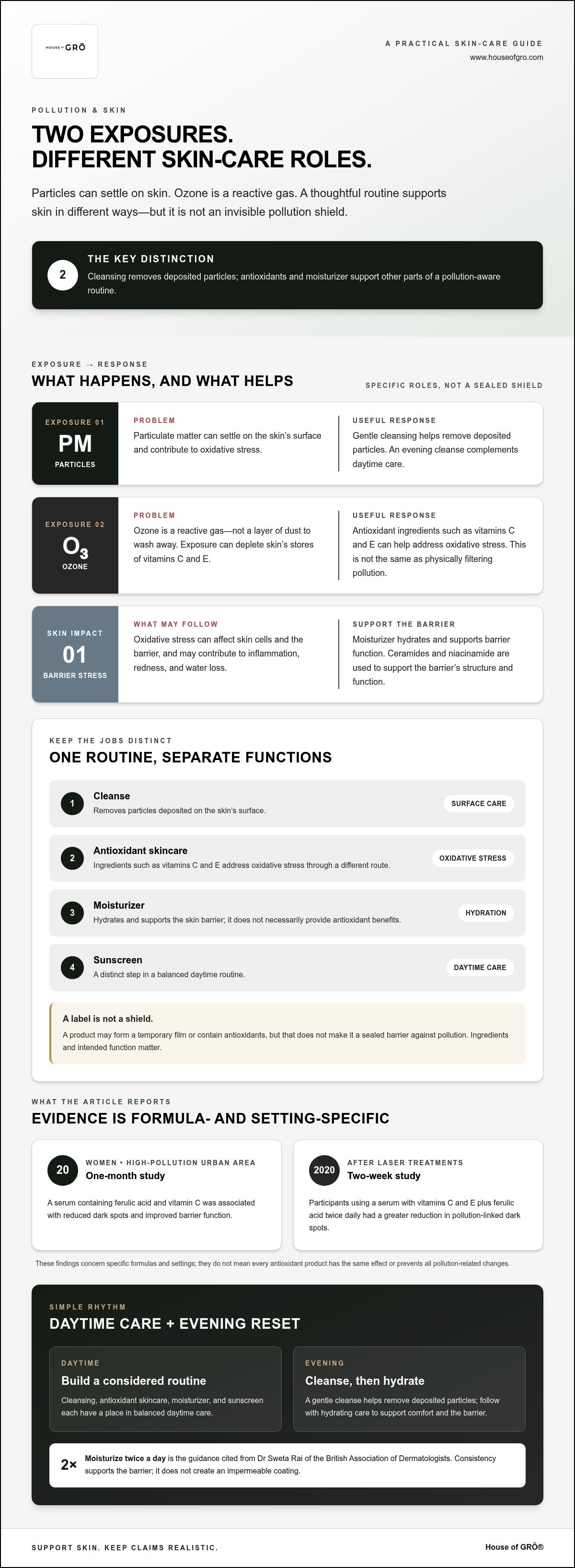
Particulate pollution and ozone affect skin in different ways. Particles can settle on the skin’s surface, where cleansing can remove them. Ozone is a reactive gas, not a layer of dust to wash away. Exposure has been shown to deplete skin’s stores of vitamins C and E, antioxidants that help counter oxidative stress. The distinction matters: cleansing removes deposited particles, while hydration and antioxidant ingredients support other parts of a pollution-aware routine.
The skin barrier is the outer layer that helps limit water loss and defend against irritants. Pollution-related oxidative stress can affect skin cells and contribute to barrier disruption, inflammation, or redness. Ceramides are lipids found naturally in the barrier, and skincare containing ceramides is designed to support its structure. That is different from physically filtering pollution. A cream’s ingredients and purpose matter more than a label promising a pollution shield.
Can an ordinary moisturizer provide the same benefits as anti-pollution products? A moisturizer can hydrate and support the skin barrier, even without an anti-pollution label. It won’t necessarily provide antioxidant benefits unless it contains relevant ingredients, such as vitamins C or E.
Hydration is a practical foundation. Dr Sweta Rai of the British Association of Dermatologists says well-moisturized skin helps maintain an intact, functional barrier and keep pollution’s effects at bay. The guidance is to moisturize twice a day. Choose a comfortable texture and apply it after cleansing, so skin feels hydrated rather than tight. Consistency supports the barrier; it does not create an impermeable coating.
Niacinamide is another skincare ingredient used to support the barrier. It can complement a moisturizer, but its presence alone doesn’t mean a product blocks ozone or traps every particle. Consider the formula’s role: hydration and barrier support are different from antioxidant action. A morning product containing antioxidants may address oxidative stress, while a moisturizer helps maintain comfort and barrier function.
Be measured about “anti-pollution barrier-shield” claims. A product may form a temporary film or contain antioxidants, but that doesn’t make it a sealed shield against pollution. Examine “protect against” claims by looking at the ingredients and intended function. A simple routine can pair a gentle cleanse after outdoor exposure with hydrating moisturizer, and include antioxidant skincare if it suits your routine. Each step has a specific role, not a promise of complete protection.
How particulate matter and ozone cause oxidative stress
Airborne particles and ozone can contribute to oxidative stress through different forms of exposure. Understanding this process helps explain why antioxidants and hydration have distinct roles in skin care.
Pollution-Related Oxidative Stress
Oxidative stress occurs when reactive molecules, including free radicals, outnumber the skin’s antioxidant defenses. Particulate matter can contribute to this imbalance after contacting skin, while ozone can react with components at the skin’s surface. The resulting stress can damage skin cells, affect the barrier, and contribute to inflammation and redness. These effects are related, but they are not the same as particles simply resting on skin.
Free Radicals and Skin Protection
Free radicals are reactive molecules that can damage cells when antioxidant defenses cannot keep them in balance. Pollution-related oxidative stress matters because cell damage and barrier disruption may leave skin feeling less comfortable. A disrupted barrier can also lose water more readily. Hydrating care supports barrier function, while antioxidant ingredients target free-radical activity through a different route.
Antioxidants are not interchangeable, and the formula matters. In controlled experiments, mixtures of topical vitamin C, vitamin E, and ferulic acid protected human skin cells from ozone-induced oxidative damage. A study involving 20 women in a high-pollution urban area found reduced dark spots and improved barrier function after one month using a serum containing ferulic acid and vitamin C. These findings point to specific ingredients, not a universal shield.
A separate 2020 study examined people after laser treatments. Those who used a serum containing vitamins C and E and ferulic acid twice daily for two weeks had a greater reduction in pollution-linked dark spots. This result concerns a particular formula and setting. It doesn’t mean every antioxidant product produces the same effect, or that skincare prevents all pollution-related changes.
Hydration addresses another part of the picture. Moisturizing helps maintain an intact, functional skin barrier, supporting comfort and helping limit water loss. Dr Sweta Rai of the British Association of Dermatologists recommends keeping skin well moisturized to help keep pollution’s effects at bay. Hydrating care and antioxidant ingredients can therefore serve complementary purposes, rather than asking one product to do everything.
For a simple routine, use antioxidant skincare in the morning and moisturize to support the barrier. At night, cleanse away deposited particles and follow with hydrating care. An antioxidant-rich diet with green leafy vegetables and fruits can also help fight free-radical damage. If you’re considering a hydrating step for body skin, explore hydrating body skincare.
How pollution affects skin
Research links traffic pollution with more pigment spots, while ozone exposure has been associated with inflammatory skin conditions. These findings point to possible visible effects, not a prediction for every skin type.
Visible Effects of Pollution on Skin
Visible effects associated with pollution include dark spots, redness, hives, eczema, and contact dermatitis. A long-term population study linked traffic-derived soot and particles with about 20% more pigment spots on women’s foreheads and cheeks. Later research also linked higher nitrogen dioxide levels with more dark spots.
A 2011 Chinese study linked higher ozone pollution with increased emergency-room visits for hives, eczema, and contact dermatitis among nearly 70,000 people. These findings describe associations across populations. They don’t mean every spot or flare comes from pollution. Skin type, other environmental exposures, and individual sensitivity can also shape what someone notices.
Antioxidants for Pollution-Related Damage
Antioxidants help address free-radical activity associated with pollution-related oxidative stress. In controlled experiments, topical mixtures of vitamins C and E, plus ferulic acid, protected human skin cells from ozone-induced oxidative damage. This evidence helps explain why antioxidant ingredients appear in daytime skincare, though a formula’s ingredients matter more than an “anti-pollution” label.
Dr Sweta Rai says topical or dietary antioxidants have been shown to help maintain healthy skin and prevent pollution’s detrimental effects. A practical approach is to use antioxidant skincare as one part of a routine, alongside gentle cleansing and barrier-supporting hydration. Green leafy vegetables and fruits are another way to include antioxidants in your diet.
The Skin Microbiome and Pollution
The skin microbiome is the community of microorganisms living on the skin’s surface. Probiotic and prebiotic skincare ingredients are designed to interact with that environment in different ways. Their presence alone doesn’t show that a product protects against pollution. For a pollution-focused routine, consider the formula’s intended role and whether it suits your skin type.
Keep your routine gentle if skin feels reactive. Cleanse away deposited particles, then use hydrating care to support the barrier. An antioxidant product may address oxidative stress, while moisturizer supports hydration; these steps serve different purposes. If a new product causes discomfort, simplify your routine rather than layering on more ingredients. Persistent redness or eczema deserves attention as a symptom, not simply as proof of pollution exposure.
Cleansing to remove deposited particles
Airborne particles can settle on exposed skin during an outdoor commute, a walk, or time near traffic. Cleansing removes surface deposits, but it does not reverse every effect associated with pollution. The practical guidance is to cleanse as soon as reasonably possible after being outdoors. For example, after arriving home, use a gentle cleanser rather than leaving accumulated residue on your skin until bedtime.
At night, a double cleanse can help lift residue in two stages. Start with a cleansing oil to loosen oil-based residue and makeup. Follow with a gentle cleanser to wash the skin’s surface. Use a light touch and rinse thoroughly. Scrubbing harder won’t improve the routine; it can make cleansing uncomfortable, especially if skin is already dry or sensitive.
Moringa extract appears in some cleansing products marketed for pollution. Its presence alone doesn’t show how effectively a cleanser removes deposited particles. The cleansing step, formula, and thorough rinsing all matter. Treat claims about “pollutant removal” as specific to the product, rather than assuming one botanical ingredient creates a protective layer or replaces cleansing.
Make the routine fit your skin’s condition. If a cleanser leaves skin feeling tight, try a gentler formula or avoid unnecessary scrubbing. If you wear makeup or water-resistant sunscreen, an oil cleanser followed by a gentle cleanser can provide a clear two-step evening routine. Cleansing as soon as reasonably possible after outdoor exposure also means you don’t have to wait until the end of the day.
After cleansing, support comfort with hydration. A moisturizer containing hyaluronic acid can hydrate, but it serves a different purpose from cleansing and doesn’t remove particles. Likewise, vitamin C is an antioxidant ingredient used in skincare, not a substitute for washing away surface residue. Keeping these roles separate makes the routine simple: cleanse to remove deposits, then choose skincare according to what your skin needs.
More cleansing isn’t automatically better. Repeating a double cleanse several times can leave skin feeling stripped, while one thorough cleanse may suit a day with little makeup or sunscreen. Notice how your skin feels after rinsing, and keep the second cleanse gentle. The goal is clean, comfortable skin, not a squeaky finish.
At night, use the oil-then-gentle-cleanser sequence to remove the day’s buildup, then follow with hydrating care. In the morning, cleanse according to your skin’s needs before applying daytime skincare. This steady pattern makes cleansing a practical part of pollution-aware care, without suggesting a cleanser can block future exposure.
Daytime anti-pollution skincare routine
A useful morning routine has distinct steps: gentle cleansing, antioxidant skincare, moisturizer, and sunscreen. Each serves a different purpose. Cleansing removes residue, antioxidants help address free-radical activity, moisturizer supports the skin barrier, and sunscreen protects against UV radiation.
There is no single set cost for anti-pollution skincare products in the United States. Cost depends on product type, formula, package size, and brand, so compare ingredients and purpose rather than relying on a label alone.
Possible side effects depend on the ingredients and your skin’s response. A new serum may cause irritation, so introduce one new product at a time and stop using it if discomfort develops.
Use this order to keep the routine clear:
- Cleanse gently. Start with clean skin. Choose a cleanser that leaves your face comfortable, not tight.
- Apply antioxidant skincare. Use a morning antioxidant serum after cleansing. Vitamin C is one example of an antioxidant ingredient used in skincare.
- Moisturize. Apply a moisturizer that feels hydrating and supports the skin barrier. This step complements antioxidants rather than replacing them.
- Finish with sunscreen. Use environmental protection as part of daytime care. Mineral sunscreen with an SPF of 30 or greater is recommended as a physical barrier against UV rays and pollutants.
Keep sunscreen central to your routine. UV radiation and air pollution can amplify one another, so an antioxidant serum isn’t a substitute for sun protection. SPF indicates protection against UVB rays, while a separate star rating measures UVA protection. Apply sunscreen as the final skincare step before makeup or going outdoors.
Not every routine needs a product marketed specifically for pollution. Caroline Hirons says thorough cleansing, sun protection, and possibly a basic vitamin C serum may be enough. So, does anti-pollution skincare really work? It can support a routine through targeted ingredients, without requiring layers of products with overlapping purposes. At night, cleanse thoroughly to remove particles deposited during the day.
If you’re asking, “does anti-pollution skincare really work for a simple morning routine?” focus on what each step contributes. Introduce new products one at a time and keep the routine comfortable. If a vitamin C serum feels irritating, simplify your skincare rather than adding another new active ingredient.
For a considered daytime skincare step, explore daytime skincare and keep your routine grounded in cleansing, antioxidant care, moisturizer, and sunscreen.
House of GRŌ®: AT DAWN Rejuvenating Daytime Oil
AT DAWN Rejuvenating Daytime Oil from House of GRŌ® offers a considered oil step in a morning skincare routine. House of GRŌ® formulas draw on adaptogenic mushrooms and organic botanicals, including wild-harvested Chaga, an antioxidant ingredient. Use a daytime oil as part of your skincare practice, not as a substitute for cleansing or sunscreen. No skincare oil creates a complete barrier against pollution.
Choose a routine that feels comfortable and purposeful. Gentle cleansing, daytime skincare, and sunscreen remain distinct parts of pollution-aware care. AT DAWN can be a fitting option if you want to include a daytime oil in that routine.
Visit House of GRŌ® to explore AT DAWN Rejuvenating Daytime Oil.
Make your next skincare step intentional
Let your routine be guided by what your skin needs, not by the number of products promising protection. A steady practice is easier to understand and maintain. Introduce changes thoughtfully, notice how your skin responds, and keep each product’s purpose clear. That way, skin care feels considered rather than complicated.
If you’re asking, “Does anti-pollution skincare really work?” the most useful answer is grounded in realistic expectations. Skincare can support skin through targeted ingredients and consistent habits, but a routine need not become an elaborate defense plan. Choose steps that fit your day and make them part of a calm, repeatable ritual.
For guidance as you shape a routine around your preferences, contact House of GRŌ® for skincare advice. A thoughtful next step can be simple, personal, and easy to return to.
Frequently Asked Questions
What is pollution?
Pollution is the presence of harmful substances in the environment, including airborne particles and gases such as ozone and nitrogen dioxide. For skin care, the distinction matters: particles can settle on the skin, while ozone is a gas that interacts differently with skin. These exposures can contribute to oxidative stress. Thinking of pollution as more than visible dust helps explain why cleansing and antioxidant ingredients have separate roles.
Can air pollution cause itchy skin?
Air pollution can be associated with itchy skin conditions, including hives and eczema. Ozone pollution has also been linked with emergency-room visits for eczema, hives, and contact dermatitis. If your skin feels itchy after time outdoors, note where and when symptoms appear and whether a new skincare product could also be involved. Itch alone can’t identify the cause.
Do 'anti-pollution' serums really work, or is it marketing?
Some serums contain antioxidants intended to help address oxidative stress, so the label may describe a genuine formulation purpose. But “anti-pollution” doesn’t prove that a serum blocks every pollutant or suits every routine. Look at the ingredients and the product’s role. A serum with antioxidants differs from a cleanser, which removes particles from the skin’s surface.
Does pollution cause premature aging?
Research has linked traffic-derived soot and particles with more pigment spots, a visible change that can be associated with aging. Pollution can also contribute to oxidative stress and affect skin cells. These findings do not establish that pollution is the only cause of an individual’s skin changes. Sun exposure, skin type, and other environmental factors can also shape how skin looks over time.
How should I cleanse my skin after being exposed to pollution?
After being outdoors, cleanse as soon as reasonably possible with a gentle cleanser. At night, if you’ve worn makeup or sunscreen, use a cleansing oil first, then follow with a gentle cleanser. Rinse thoroughly and avoid scrubbing to remove particles. If skin feels tight afterward, choose gentler cleansing and add hydrating care rather than washing again.
What's the best skincare defense against pollution?
A balanced routine combines steps with different purposes: gentle cleansing, antioxidant skincare, moisturizer, and sunscreen. For daytime, mineral sunscreen with an SPF of 30 or greater is recommended as a physical barrier against UV rays and pollutants. Antioxidants complement sunscreen, but don’t replace it. At night, cleansing helps clear surface deposits, while moisturizer supports skin-barrier function.
What does anti-pollution skincare claim to do?
Anti-pollution skincare is formulated to help care for skin exposed to everyday pollution. Depending on the product, that may mean cleansing away deposited particles, using antioxidants to address free-radical activity, or supporting the skin barrier with hydration. These are different functions. Check the ingredient list and intended role rather than assuming one formula removes particles, hydrates, and shields skin all at once.
Do antioxidants in skincare protect skin from air pollution?
Antioxidants can help protect skin cells from pollution-related oxidative damage. Controlled experiments found that topical mixtures of vitamin C, vitamin E, and ferulic acid protected human skin cells from ozone-induced damage. This supports using antioxidant ingredients as part of skincare, but it doesn’t mean they form a complete shield. Pair antioxidants with cleansing, moisturizer, and daily sunscreen for a considered routine.